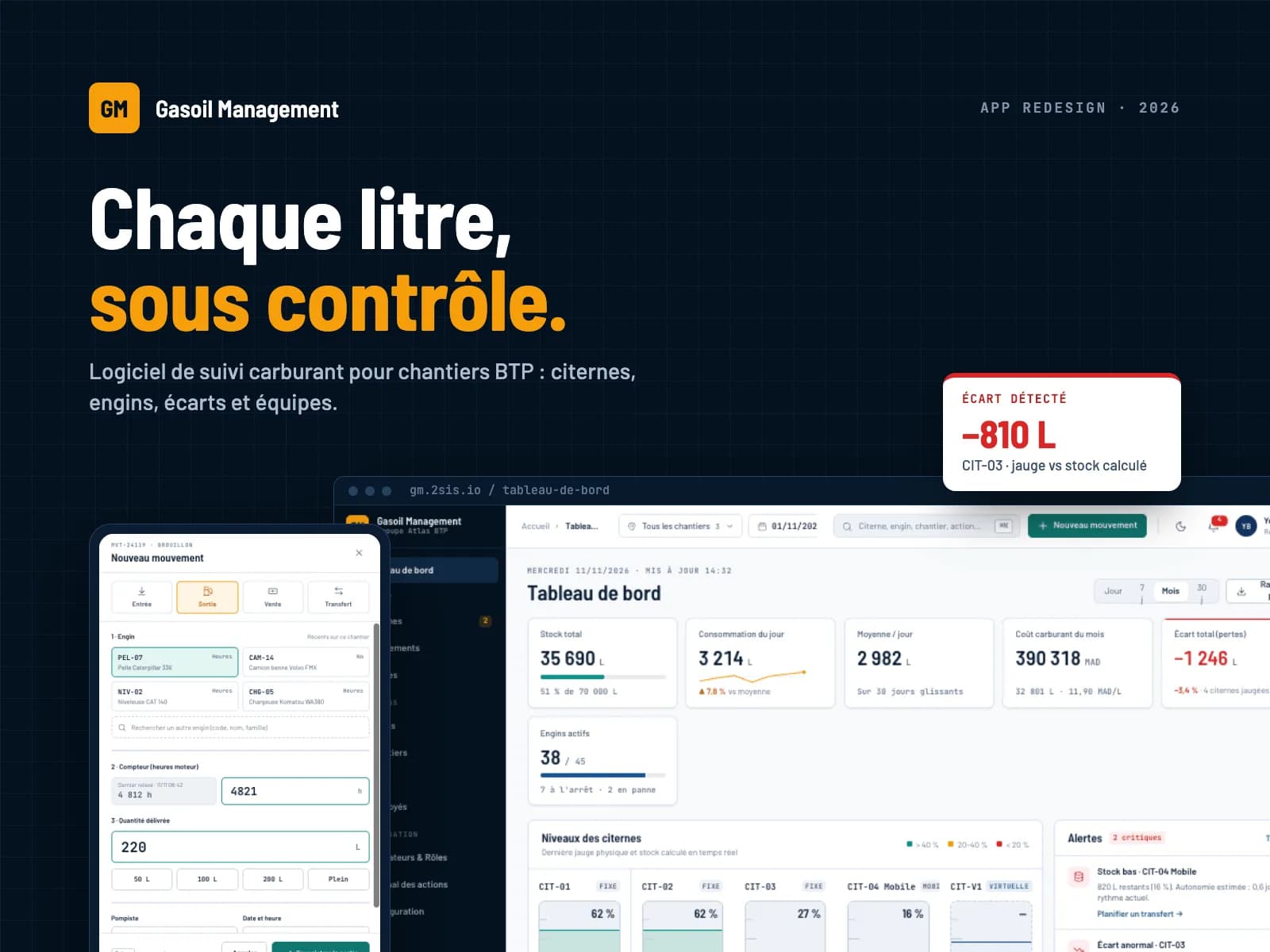
GM — Diesel management
The diesel management platform that tracks, controls and optimizes tanks, machinery, vehicles, sites, movements and consumption in real time.
- React 18
- TypeScript 5.6
- Vite 5.4
- Redux
- Spring Boot
- Leaflet
- SECTOR
- Energy · Fleet
- STATUS
- Delivered
- TYPE
- SaaS platform
- MODULES
- 8
The platform in pictures.
Business challenge
Control losses, theft, gauging gaps and diesel cost allocation in high-consumption multi-site operations.
GM (Gasoil Management System) digitizes the entire fuel chain, from diesel entering a tank to its consumption by a machine, its sale to a third party or its transfer to another site.
The platform replaces paper logs, Excel sheets and WhatsApp reports with a single auditable source for operations managers, site managers, finance teams and controllers.
It scales from ten vehicles on one site to hundreds of machines spread across a national network of sites, tanks and teams.
Problems solved
BEFORE- 01Fuel movements recorded on paper or in isolated files
- 02Physical tank levels hard to reconcile with system stock
- 03Little visibility on consumption and profitability per site, machine or vehicle
- 04Access rights and traceability insufficient for audits and public contracts
Key features
- 01
Tanks
Fixed or mobile tanks, capacity, level, alert threshold, location and assigned site.
- 02
Machinery and vehicles
Bulldozers, excavators, trucks, generators and vehicles with consumption profile, fuel and assignment.
- 03
Sites
Tanks, machinery fleet, staff and indicators for each site, with cross-site comparison.
- 04
Inflows
Deliveries with supplier, quantity, price, date and document reference.
- 05
Outflows, sales and transfers
Dispensing to machines, driver, meter, timestamp, sales to third parties and transfers between tanks or sites.
- 06
Gauging
Physical tank measurements reconciled with theoretical stock to detect losses and gaps.
- 07
Third parties
Suppliers, customers, subcontractors and partners linked to every fuel transaction.
- 08
Dashboards
Consumption, cost per site, L/h or L/100 km efficiency, losses and a Leaflet map of tanks and sites.
(Operational pipeline)
From need to result, without breaks.
- 01
Configure
Create the organization, tanks, sites, machinery, users, roles and permissions.
- 02
Receive
Record each diesel delivery into the tank with supplier, price and receipt.
- 03
Dispense
Trace each outflow to a machine or vehicle with driver, meter and time.
- 04
Reconcile
Regularly compare physical gauging with the stock calculated by the system.
- 05
Analyze
Track consumption, cost, efficiency and anomalies, then export financial and audit reports.
How the platform is built.
Technical choices
Industrial frontend
- Type-safe React and TypeScript UI
- Predictable state with Redux Toolkit
- Protected routes and validated forms
- Chart.js charts and Leaflet mapping
Secure backend
- Spring Security and @PreAuthorize
- Hierarchical permission evaluator
- JWT in HTTP-only cookies
- Audit of every fuel movement
Deployment
- Reproducible Docker containers
- Linux, on-premise datacenter or private cloud
- AWS, GCP, Azure, OVH or Scaleway
- Externalized configuration per environment
- React 18
- TypeScript 5.6
- Vite 5.4
- Redux
- Spring Boot
- Leaflet
- 01Construction and public works companies
- 02Mines and quarries
- 03Carriers and fleet managers
- 04Industrial sites with internal storage
- 05Public contract holders subject to audit
- 01Immediate loss detection through gauging reconciliation
- 02Diesel cost allocated per site and per machine
- 03Fewer paper logs and less re-keying
- 04Full regulatory and contractual traceability
- 05Scales from one site to a national network
Results and impact
AFTER- Theoretical stock and physical level comparable at any time
- Abnormal consumption identifiable by driver or machine
- Better project profitability through precise cost allocation
- Complete history of inflows, outflows, sales and transfers
- A single source for operations, finance and audit
Everything about GM.
Have a similar project in mind?
Let’s talk about your processes and the platform that will make them reliable, traceable and manageable.
Yes. Each site has its own tanks, machinery, assignments, stock and reports while remaining visible in a consolidated view.
Spring Security and @PreAuthorize enforce hierarchical permissions. A site manager can be limited to their own site's movements.
Yes. Docker containers run on Linux, in a datacenter, private cloud or public cloud such as AWS, GCP, Azure, OVH and Scaleway.
Yes. Its REST API can exchange data with SAP, Oracle, Sage, Odoo and custom accounting systems.